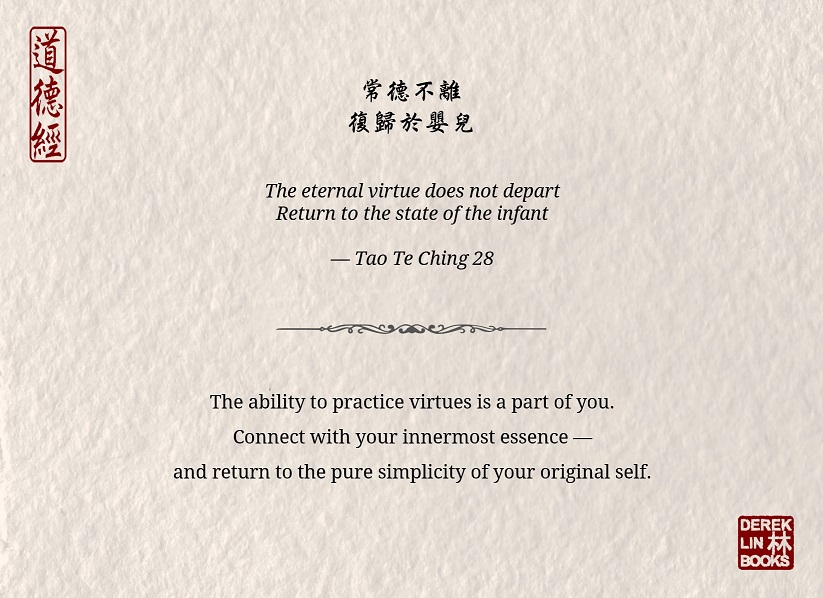
In certain circles, it is popular to talk about the name
Lao Tzu (or Laozi) having the dual meaning of "Old Master" and
"Ancient Child." Some feel that this is a higher level of wisdom
that points to the childlike sense of wonder and the state of grace that
are at the heart of a Taoist sage.
It sounds really cool, but it's not true. Lao Tzu / Laozi definitely
does not mean Old Child, Ancient Child, Old Son, Ancient Son, Old Boy,
Ancient Boy, or other similar permutations. In this context the
character tzu or zi can only mean "master" or "great
teacher." In another context, combined with other characters, it
can mean "child" or "son." In this context it has no
such meaning. Not
today nor in ancient times.
Upon hearing this, some may shrug and say: "Whatever. I'll just let
the scholars fight it out." This assumes the point is a matter of
scholarly debate, but it's not. It's simply a matter of logic and actual
(as opposed to imagined) linguistic meaning. To a native speaker of
Chinese, there is no controversey.
When applied as an honorific, the tzu character is used for many
other great teachers from Chinese history. Some of the better known ones
in the West are Chuang Tzu, Sun Tzu, and Confucius (Kong Tzu). In the
Pinyin system these would be written as Zhuangzi, Sunzi, and Kongzi
respectively.
The tzu character is used in the exact same way for all of
these sages (for our specific examples, we can also note that it is used in the exact same way
for them during the same period in Chinese history). Therefore, if it really does have
a dual meaning for Lao Tzu, it must also have the same dual meaning for all of them. This means Chuang Tzu becomes "Chuang Child," Sun
Tzu becomes "Sun Child," Confucius becomes "Kong Child," and so on for
all the other sages with the same title.
Some of the people who think
Lao Tzu means "Old Child" also believe that Taoism is diametrically
opposite to Confucianism. To them, the idea that the strict, un-Tao-like
Confucius can be the Kong Child would probably not sit too well.
And how about the Art of War having been written by the
Sun Child? Does that point to the hidden wisdom that warfare is, um...
child's play?
Clearly, this makes no sense. The idea that Lao Tzu
means "Ancient Child" is in fact a misuse of language that
leads to strange conclusions - unless we can come up with
additional, equally contrived theories to explain why it's true only for Lao
Tzu, or perhaps only for Taoist
sages, but not for anyone else.
How did the misconception come about in
the first place? There are several primary sources: 1) superstitious
stories invented by the Chinese about Lao Tzu being born old; 2) Western
misunderstanding of the Chinese language, largely by academics who can't
speak Chinese but are
nevertheless seen as authorities on the subject; 3) puns made by the Chinese, not
intended to be taken seriously; 4) a few Chinese people who perpetuate
the misconception because they don't know
their own language all that well, thereby unwittingly giving the notion
an aura of authenticity (if a Chinese person says Lao Tzu means Old
Child, then you just know it has to be true).
In spoken Chinese, the two characters lao tzu can have
another meaning when used in another context, but it's like
absolutely nothing imagined by Western academics.
In this other
context, the tzu character looks the same but is pronounced in a different pitch. An
English speaker probably won't be able to tell the difference. When
pronounced this way, the meaning is 1) father and 2) a rude and crude
way to refer to oneself.
For instance, when a bully wants to pick a
fight, he may say: "lao zi zo ni!" This can be translated as
"I'll beat you up!" And if we break it down linguistically, we'll see
that what it says has the compressed meaning of: "I, your old dad, will
beat you up!"
The rude and crude part of it is the assertion of
oneself over another, similar to the American expression, "who's your
daddy?" Only someone who has no class would be so insulting to someone
else. Therefore, the phrase can only be suitable for people at
the lowest level of Chinese society - illiterate and ignorant criminals, gangsters, thugs, and so on.
Note that in this situation the reality
is almost the exact opposite of the misconception. The alternative
meaning of lao tzu turns
out to be more like father than son.
Note also that none of this
implies that the original author of the Tao Te Ching has a name that can mean
"Old Master," "Father" and "Self" all at the same time. The
different contexts
don't mix at all. Nor do they "bleed" into each other. Some Westerners
may have trouble understanding this point, but there is no mystery to
it. It's common to most languages.
For instance, in English, the word
"fast" means completely different things when we say "that car is fast"
(meaning quick), "hold fast" (meaning unmoving), and "starting a fast"
(meaning food restriction). We're pretty comfortable with the different
contexts, we know they have nothing to do with one another, and we can
figure out the intended meaning based on the other words that are being
said in conjunction. It's exactly like that with Chinese.
How can the
few Western writers who are still enamored with "Ancient Child" be so
far off the mark? Friends who
know me constantly hear me say that the study of the Tao in the West is
filled with numerous misconceptions - but I think even they will be
taken by surprise when they glimpse the full extent of the situation.
If you are reading this and you know Chinese, or have a friend who does,
you can take a look at
this dictionary entry (Lao Tzu as the author of the Tao Te Ching) and
this one (lao tzu as the vulgar expression). Note that the characters are exactly the same,
the pronounciation keys are slightly different, the
definitions are completely different - and neither one has anything to do
with "Ancient Child."