
Overcoming Ignorance
Ignorance seems to be a universal condition. In some way and to some degree, we are all ignorant. To a certain extent, we are all victims of illusion. This essay is designed to give readers some guidance on how they could assess their own "degree of ignorance", and how they could overcome it. Becoming aware of one's own ignorance is the first step towards getting rid of ignorance. It is a thinking process, but also one of taking concrete steps in real life. It is an act both of analysis and commitment. No matter how wise or compassionate one is, there is always room for improvement. Becoming wise and compassionate is a never ending quest. B. The root of sufferingIgnorance is the root of suffering. Hinduism, Taoism and all schools of Buddhism, including Ch'an and Zen, but also many Christian schools of thought, agree on this. Ignorance is more than just the absence of knowledge, even though a lack of knowledge is often part of the condition. It is the negative opposite of wisdom: the absence of qualities associated with wisdom. Ignorance also implies a lack of compassion, and as such it constitutes a self-centered attitude and its subsequent destructive approach to life. It is a life of greed and hatred instead of compassion and wisdom. It is to fall victim to illusions of permanence and materialism - the inability to distinguish between the real and the fake, and the failure to choose priorities correctly. In Zen, ignorance is seen as the antithesis of enlightenment. Enlightenment is to be freed totally from ignorance. Ignorance in Taoism is often described as disharmony with the Tao. It is a state of control by the ego, a restless condition of volatility dominated by illusion and destructive emotions. This state of disharmony with the Tao can only be overcome when one manages to strip oneself of a false sense of self, illusion and pretense. To be freed from ignorance is an awakening process - often gradual, but with brilliant moments of keen insight - and it entails the discovery of the true self and the transformation that accompanies it. It is a movement from disunity towards unity with all of creation. Ignorance is the source of most suffering, yet it is "curable". It is a state of mind anyone - even the wise - can fall prey to, but it is a condition anyone can be liberated from - even those who seem to be inextricably enmeshed in it. We live in a world promoting ignorance, vivifying the illusionary, and ignoring, even denying, the true essence of things. Fighting ignorance has therefore become a constant vigil against negative influence, which can take the form of peer pressure, the group mind, government propaganda, or subtle and brash forms of an omnipresent advertising industry. Our consumer society is focused on evoking greed and inflating the ego, and it is difficult to isolate ourselves from its negative influences. Governments often fan the flames of blind patriotism. Often, our professions, social pressures and education promote and demand an egotistical life style which runs contrary to a compassionate and wise approach to life. Many people seem to have no alternative but to follow life styles which strengthen their own egos and ignorance. In this environment hostile to the spirit, it is difficult to rid oneself of ignorance and to move with the freedom only harmony with the Tao, and compassion and wisdom, can bring. C. Aspects of ignorance1. Lack of right knowledge Our society is saturated with ignorance. It is close to impossible to escape ignorance and its shackles. This ignorance is often based on a gross lack of the most basic knowledge of matters of the spirit. Society is rife with falsities, superstitions and misunderstandings. People often spend many years of their lives totally immersed in an illusionary, deceptive world. This causes them to suffer, and even worse, to cause suffering to others. There are many falsities that must be identified and discarded before one could even start developing oneself properly. What follows is a list of some of these false assumptions and superstitions which bind one to a world of illusion.
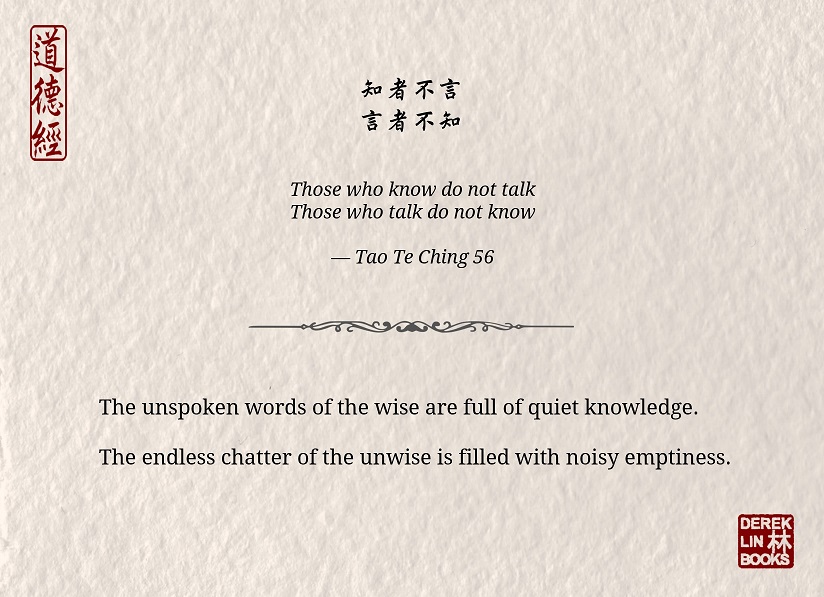
The sage knows
Confused,
Why do I cling to myself (The Tao is Tao, 34)
You and you alone can salvage your life.
The ignorant The Taoist sage The person in close harmony with the Tao The Taoist sage lives (The Tao is Tao, 39)
The Tao is silence (The Tao is Tao, 2)
The ignorant (The Tao is Tao, 47)
2. Lack of faith Ignorance (The Tao is Tao, 46) Faith is our effort to deal with the mysterious. Once something has lost its mystery and we understand it, we do not need faith to deal with it. The Tao as well as our spirit will forever lie in the realms of the mysterious, and will therefore always require a great deal of faith from us. Faith means trust and acceptance: True faith (The Tao is Tao, 22) There are many unprovable aspects that will just have to be accepted by us. We need the faith of a child to do so. Of course, our critical rational faculties will object vehemently against this gagging of our intellect. But we have no choice. If we refuse to take this upon ourselves, we will never be able to enter the spiritual realm. To step into the realm of the spirit (The Tao is Tao, 17) Particularly at the beginning of our development, we obviously need a lot of faith, for we have not yet experienced on a spiritual level the revelations that will turn surmise into certainty. Until experience has confirmed our beliefs, we need faith. 3. Lack of applicationToo few people practice what they believe. Too many people are content with being armchair philosophers. Too many people today are addicted to intellectual excitement. Their effort to understand then often becomes an egotistical preoccupation with thrills of the mind. They will cling to the intellectual, which will then become a handicap and not a help on the way to harmony with the Tao. As long as you do not progress beyond the merely intellectual, you will never reach harmony with the Tao. In fact, intellectual analysis without the commitment to application ultimately confuses and increases disharmony and agitation. Moving towards the Tao is not only an intellectual exercise. It is real movement which finds fulfilment only in the experiential sphere. It is not only talking about compassion; it is practicing it as well. It is not just discussing wisdom; it is also living it. It is not merely considering theoretical possibilities; it is to be in the thick of life, acting intuitively where there is the need to act, and to refrain from action where it is wise to do so. It is to speak out when compassion compels you to, and to shut up when wisdom demands it. Theory is cheap. A life of the spirit is real, and demands its price. The Buddha warned against accepting any so-called "spiritual truth" unless you have tested it yourself and found it to be true. Wiser advice has never been given. Once you have started on your way, never give up. Be patient and resilient, no matter what happens to you, and no matter how many setbacks you suffer. Never turn back. Show grit. Have courage. Have faith. Never give up. 4. EgotismEgotism is certainly the main stumbling block in destroying ignorance and becoming wise. The belief in a permanent "I" and in the permanence of things combine to form a terrible obsession, in which the main aim becomes the glorification of self. This self, however, is a false one, a contrived image of who you are supposed to be. It enslaves its believer and often drives him to hyperactivity and distress. 5. Dualistic thinking on a spiritual levelMany people allow their rational faculties to interfere with their spiritual life. This causes many problems. The rational separates, whereas the spirit strives to unite. The rational spotlights differences, the spirit emphasizes sameness and identity. As long as you limit the rational and the analytical to its own sphere, where it has a legitimate and essential function, no problems will occur. Problems ensue when your discriminatory faculties intrude upon matters of the spirit. The discriminatory faculties tend to undermine faith. For example, trying to explain the inexplicable causes confusion and not clarity. We have already mentioned what happens if you want to define god: you then turn god from a source of spiritual power into something that can be packaged and sold by organizations to increase their own power. There is quite simply a limit to our rational abilities. There is a point in our spiritual development where only faith and commitment will allow us to progress. A terrible byproduct of dualistic thinking on a spiritual level is the belief that things are really separate. We start believing that the "reality" created in our minds is real. We lose sight of the fact that separation is artificial and does not exist. In a state of ignorance, we tend to be unaware of the confusing influence that language has on our ability to progress. For example, we tend to think that the "spiritual" and "material" levels are two separate levels, and we do not realize that it is our thinking that separates these two aspects. What we fail to see is that, in fact, the spirit and our bodies are identical. Not realizing this can lead to much confusion and suffering. D. Behavioral Symptoms of IgnoranceBehavioral symptoms of ignorance may be clearly visible to outsiders, but the ignorant are mostly unaware of their own ignorance. What follows is a list of what could be symptoms of ignorance. They might indicate where you can improve. Many of these symptoms might seem obvious, but make no mistake. They can manifest themselves in subtle, discreet, almost invisible forms. Your own ego, too, has a way of presenting itself in forms acceptable to your conscience. Do not be fooled by it. What all these symptoms have in common is a lack of compassion. In fact, ignorance can be defined as any state of mind other than compassion. 1. Talking too muchTalking too much is often based on an overestimation of your ability to grasp subject matter. It could also be the result of your underestimation of the difficulty of subject matter. Ignorant people are often too eager to give their opinions on complex matters. They often rush in "where angels fear to tread". The wise are aware of their limitations, and with this in mind, they will carefully search for solutions. Talking too much is often a manifestation of an inflated ego. For more information on this aspect, read the essay "Talking: A Problem and a Challenge"at www.truetao.org/the way/talking.htm. 2. Closed mind In spite of their talkativeness, ignorant people do not want to get involved in true and vigorous exchanges of ideas. Their conversations are often monologues designed to impress. They are bad listeners, because they have usually made up their minds, and do not plan to change their minds. They are too insecure to change their minds. They are quick to criticize others, but cannot take criticism themselves. They are too scared to change their ideas or behavior. They will not admit being wrong, and they are more interested in appearance than true substance. 3. Egocentrism Ignorant people are egocentric. They are focused on themselves, their careers, their development, their agendas and their interests. They show very little interest in anyone else's concerns but their own, except when somebody else's activities could be of benefit to them. 4. Inflexibility Ignorance is often betrayed by inflexibility. Ignorant people often show off impressive agendas. Their agendas of self-interest often become their focus, and they refuse to deviate from their carefully planned strategies. They have no time for spontaneity and intuitive moments of compassion or just sheer joy. Ignorant people will often become slaves of schedules or aims, forgetting totally that life is there to be lived, and not to be enslaved to. 5. Ambition Ignorant people often tend to be exceedingly ambitious, and their ambition is clearly centered in the service of their own selves. An integral part of their ambition is to outperform competitors and opponents. It is to become the center of attention and admiration. Even when their work is of a "spiritual" nature, they will still be plagued by egocentric ambitions which diminish or pervert their work. 6. Vanity Ignorant people tend to be very vain. They are very worried about appearance, and what others think of them. Maintaining appearance is an obsession with them. For this reason they are susceptible to manipulation and corruption. Their fear of losing face will cow them into submission at the cost of betraying themselves. 7. Desire for status Ignorant people crave status, or at least the appearance of status. They tend to see status as of greater substance than true performance, and they often surround themselves with superficial artefacts depicting status.
Their desire for status often turns them into individuals easily cowed by the specter of losing the good opinion of society. Reputation is high and integrity low on their priority list. Their fearful little minds search desperately for the warmth of recognition and acceptance. 8. Envy, jealousy, meanness Ignorant people are often so dedicated to the ego that they cannot tolerate people close to them being successful. The last thing they can do is genuinely rejoice in the success of their "friends" or peers. They are forever enviously measuring the success of those they deem to be in competition with themselves, and they live in fear of being outdone by someone. They often small-mindedly refuse to accept any new ideas that might endanger their standing or status. They would sometimes revert to meanness to "defend" what they feel is their rank or position. They are often discreet gossip mongers, or sly backbiters, manipulating people's opinions to their own advantage. There is very little space for any form of real compassion in their lives, even though they would go to great pains to publicly demonstrate virtue. 9. Quick to condemn, slow to forgive Ignorant people are often very quick to condemn. Their condemnation is often based on prejudices and uninformed assumptions. They prefer to reflect the popular prejudices and sentiments which promote their status. They are quite easily cowed by the group mind. In fact, they have few real principles they would not betray when faced by rejection. Often, ignorant people are slow to forgive because they refuse to take the bigger picture into consideration, and because compassion does not play a role in their lives. 10. CynicismThe most dangerous form of ignorance is that of deliberately making the wrong choices, in spite of knowing they are wrong. People doing this are often beyond help, and can only be wrenched back to sanity by extremely traumatic experiences in their own lives. 11. Driven by emotions Ignorant people are often driven by their emotions, and they tend to be as fickle and unreliable as their emotions. Their mood swings determine the level of their commitment and devotion. They tend to accept their emotions as reality, and would therefore often be enslaved by them. Desperate and ignorant people (The Tao is Tao, 92) 12. Easily captured by ideas Ignorant people lack the critical faculties to evaluate concepts and ideas, and they therefore easily fall prey to ideologies. In this way, they would easily allow a concept to influence them and govern their actions. They lack the awareness that they can easily be ruled by things they are not aware of, particularly destructive tendencies in their own minds. 13. Lack of perspective Often the thinking of ignorant people lacks perspective. They do not have the detachment to evaluate their own ideas. They refuse to think critically about their own thinking. In this way, they become slaves of their own thoughts. Thoughts (The Tao is Tao, 65) 14. Feelings of superiority
Pride is mostly a symptom of ignorance. Humility is a natural product of true understanding. The moment you understand the whole, you realize that you are not better than a person who has fallen by the wayside. Looking down on others is a sign of ignorance. When you truly understand, you will stop condemning others. Feelings of superiority prevent compassionate action. They allow prejudice and hatred to flourish. They constitute a terrible form of ignorance. 15. Materialism The most obvious symptom of ignorance is a life devoted primarily to material gain beyond basic necessity. People focused on material gain are often chasing illusions of permanence, and will never find real satisfaction. You find this form of illusion even among religious people, who will rationalize their greed with "spiritual" argumentation. Materialism is linked to ego and dependence on status. It is a terrible form of captivity. Freedom linked to materialism is an illusion. Democracy based on greed and material wealth will never bring true justice and freedom to its people. True liberation is a spiritual one. 16. Impatient action In ignorant people, impatience and action often combine in a very destructive way. Driven by their ego and their own ambition, ignorant people lack the patience to wait for the right moment to act. Thirsting for honor, they would not sit back and allow others to take the credit for solving problems, even if they are better able to. They are geared to short-termed strategies and solutions. Their impatience is often a result of their own greed, and it therefore often has destructive results in the long term. E. Overcoming ignoranceIgnorance is a condition encompassing all aspects of life. Overcoming it is an essentially holistic venture exacting changes of a far reaching nature. Conquering ignorance is a deeply spiritual process. As such, this process cannot be described adequately in language. Its final condition is one of complete harmony with the Tao. What follows is an incomplete list of a few important steps that can be taken to overcome ignorance, or at least to reduce it. 1. Expand your knowledge The kind of knowledge referred to here is knowledge about relevant matters of the spirit. In spite of warnings that the intellect is not the main force in spiritual development, it nevertheless still plays an important role, particularly at the beginning of one's development. There are many things one could learn through reading or conversation. Through texts, one could "meet" many great minds, and learn from them. By discussing central concepts with more advanced minds, or with compassionate and wise friends, one could learn tremendously. 2. Kill your ego Reducing the ego is essential. It is the source of too much suffering and delusion to tolerate. It is a tall order, though, for it could involve a total change in one's attitude and approach to life. To learn more about dealing with the ego, go to the essay titled "Reducing the Ego: Strategies and Tips" at www.truetao.org/the way/ego.htm. 3. Become compassionate The best way to start is to leave one's comfort zone and to become deliberately and actively compassionate. It is amazing how compassionate action can help to reduce the ego, and how it naturally increases wisdom in you. But it is essential that your compassion is not in the service of your own self. It must be true compassion, where the self has become unimportant. To learn more about compassion, read the following essays: "Wisdom and Compassion: Two sides of the Same Coin" at www.truetao.org/theway/wisdom.htm. "The Tao Te Ching: Qualities of Compassion" at www.truetao.org/theway/ttc.htm. 4. Persist Never give up. Remember that the path you have taken might be a long and strenuous one. You will need discipline as well as patience with yourself. And lots of faith. 5. MeditateFind ways of disciplining and expanding your mind Make it part of your daily routine. It is essential that you learn to be in control of your mind and your thoughts. For more information, read "Thinking: Winning the Battle of the Mind" at www.truetao.org/the way/thinking.htm. 6. Accept the mystery As has been pointed out earlier in this essay, faith does play a part. Particularly at the beginning of your development, you have no choice but to tentatively accept certain premises in good faith. As you grow in spiritual experience, you will have ample opportunity to test these premises, and uncertainties will then become certainty. But the mystery of the Tao will remain, and faith will always be essential. For more information on the role of faith, read "The Power of Faith in Tao" at www.truetao.org/the way/faith.htm. Who can think the unthinkable? (The Tao is Tao, 94) © Jos Slabbert 2001 Postal Address: P.O. Box 4037, Vineta, Namibia Fax No.: 09264 64 46 1014 E-Mail: jos_slabbert@hotmail.com This passage or excerpts from it may be reproduced for non-profit motives. |
![]()