
The Logic of Taoism

By Bill Mason

The following is an explanation, based on the writings of Alan Watts, of Taoism and Eastern philosophy. Although Taoism requires no logic and can be, as it most often is, understood intuitively and through metaphor, I have decided to take the logical approach for a change. It is suggested that you be somewhat familiar with techniques of logic before reading it.

In order to understand the logic of Taoism, you must start with a very basic axiom: the world is constantly changing. If this statement were proveable scientifically, it would undoubtedly take much time and research; such is the nature of any axiom. This axiom, as any axiom, must merely be observed and, to a certain extent, be taken at face-value.

But look around you. What isn't constantly changing? Everything is changing shape, moving to different spots, growing or disintegrating. Even if something looks like it's standing still, think deeper. There are billions of atoms that make up every object. There are billions of cells that make up every living organism. Every second, thousands of cells die, and thousands of cells are born. In objects, atoms are rapidly flying around and banging into each other. Whether noticeable or not, everything is in a constant flux of change.

This axiom must be understood and believed before anyone can begin understand the logic of Taoism. The reason for this is that many thousands of years ago, brilliant Chinese philosophers observed nature very closely and, noticing this simple axiom, developed Taoism, Zen, and many other Eastern philosophies, all of which are built, at least in part, from it. Therefore, if you disagree with this basic axiom, you will surely disagree with Taoism or any other Eastern philosophy.

From this basic axiom, comes a statement, which you have probably heard, more as a cliche than as a philosophy of life: "the only thing constant in life is change." The only thing that doesn't change is change itself. This means that change is constant, or, put mathematically, change = constant, and therefore, constant = change.

This has profound effects on our view of the universe, because traditional thinking separates constant and change, as two separate things, opposite, in fact. However, they are not separate things. Quite the contrary, they are the same thing.

Constant and change are two opposites, which I have just proven based on the axiom given earlier, are actually the same thing. Now humor me as I indulge in inductive logic. If these two opposites are the same, we can induce that all opposites are simply poles of the same underlying thing. Opposites, such as black/white, day/night, male/female, dark/light, good/evil, love/hate, self/other. In other words, the universe is based on black and white, not black vs. white. Things that we separate by means of dualism is, in reality, a continuous spectrum, and is actually not separate at all.

This might seem like a sea of technicalities, but it's extremely important in our view of the world. This means that what we see as "bad" depends on what we define as "good." From here, we are able to define "bad," simply because it is the "opposite" of good. Because we see these things as opposites, we perceive them as "separate." We only do this because we are observing the universe bit by bit, not all at once. Thus, we do not see the whole picture, the unfolding patterns; we don't see the forest through the trees. Because of this, each bit seems separate from the other bits when, in fact, they're not really separate.

It also means that "you," as a separate entity, don't really exist, because self and other are actually the same thing. You are a part of the world around you, inevitably connected in ways you can't even fathom. Just because you have a supposed "wall of skin" doesn't separate you from the world around you, because "you" and "the world around you" are actually the same.

Another important effect of this way of thinking completely changes the perspective of what I said earlier: "There are billions of atoms that make up every object. There are billions of cells that make up every living organism." This way of thought actually eliminates any separation between these "billions of atoms" and the object itself, the "billions of cells" and the living organism itself. Furthermore, the cells, molecules, atoms, and particles in your body interact with those in your skin, which in turn interact with those outside your skin. There's no real boundary between "you" and "the world outside." The boundary is only imagined. Thus the "chopping-up" effect imposed by traditional thinking is abolished completely, simply because you are not billions of cells, unassociated with those outside your skin, you are, simply, a living organism, inseparably connected with the whole.

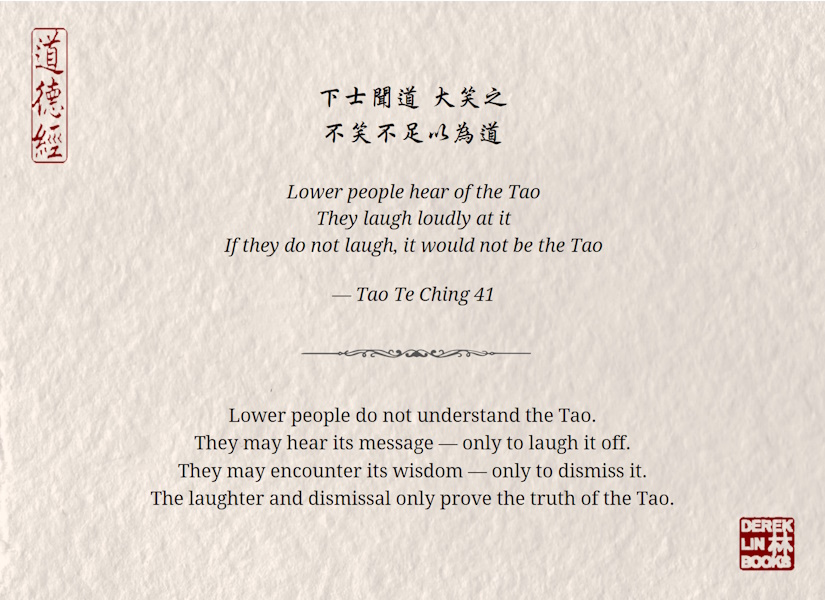
What, then, is this thing that I keep refering to as the whole? Well, it's been called a number of things. Taoists call it the Tao, Alan Watts calls it, "IT" (and he's not refering to a demonic clown), Emerson calls it "the Oversoul," and most Western thinkers call it "God." Despite all the various naming conventions, it's nature is still the same. As Shakespeare put it, "a rose by any other name is still a rose," or as Lao Tzu (the author of the oldest known text on Taoism, the Tao Te Ching), put it, as the very first words of the Tao Te Ching, "the Tao that can be named is not the true Tao. The experience that can be described is not the actual experience."

This is what Taoism is all about: finding the experience, or whatever you choose to call it. It is not the sort of religion that will "deviate you to the point of forgetting that there is anything else." The Tao is not something you need to be "tricked into" experiencing, but it does take time and contemplation. Furthermore, the Tao is never "achieved," because, to the Taoist, there is no separation between the journey and the destination, and therefore, simply by being on the journey implies you have reached your destination.